INDEX RESEARCH

Index Research will focus on a country or an issue which is of particular interest to me. Articles have appeared on http://www.afterdowningstreet.org http://www.albasrah.net http://www.aljazeerah.info http://www.bellaciao.org http://www.brussellstribunal.org http://www.globalresearch.ca http://www.informationclearinghouse.info http://www.mediachannel.org http://www.uruknet.info http://www.williambowles.info and others.

Wednesday, October 31, 2007

Is England is a better place without Blair?

by Sarah Meyer
Index Research

Email this


England is a nicer place to be right now. We don’t have the relentless siege of Blair’s lies anymore. What a relief. Blair's hubris still shines from afar as he bleats about terrorism and gives instructions about US-NATO, while earning himself £millions from speeches no one should pay to hear. Blair's shadow still hangs over us: Trident; longer pretrial detention; ID cards; 6 million surveillance cameras; shameful ‘rendition’; access to phone records by government agencies; nuclear power; and the pointless ‘robocop’ British soldiers in Basra, whose feelings are echoed by american soldiers, some of whom avoid patrol .

And Brown? Henry Porter of the Observer has him, and Jack-be-nimble-Straw, sussed. Brown should sack this Blair cabinet minister and replace with someone who doesn't feel like part of the Gestapo Gang. Why is secret funding for GM crop projects tolerated? Why the dangerous backdown on climate change? Why is Brown allowing the US to upgrade the air base at the British island protectorate of Diego Garia for their Iran attack plans? Why is this very same island allowed to be used for secret prisons? Visiting King Abdullah of Saudi Arabia is getting the Red Carpet treatment. What will Gordon Brown discuss with him? More arms agreements with discredited BAE? Torture evidence? Containing the Bush bombs in Iran? Why is Brown sending 850 more troops to Iraq despite an earlier pledge? And why is he sending Scottish troops to a "lost" Afghanistan which "cannot be won" ?

The Scottish National Party’s Alex Salmond better represents the hopes of Brits than does Brown. But. Does Scotland need a new Bioterrorism Bill?

Steve Bell, Guardian 10.10.07.

So we in England hold our breaths, hoping Brown can extricate himself from Blair- Bush policies which increased the likelihood of terrorism in Great Britain. Omens and fuzzy messages don't bode well. "Regain trust?" Not yet, Mr. Brown. Can Brown show leadership? And if Brown accepts and acts upon the policies enshrined in Bush's Terrorism Prevention (sic) Act , we are in deep shit. Maybe England won't be a better place after all. Meanwhile, it is a good idea to follow Nick Rosen’s advice: Ten Ways to Thwart Big Brother.

+

Jennifer van Bergen recently said in an email: “So many good new films coming out. As the dictatorship rises, so does the tide of films and articles (finally) expressing outrage. Where were they 2, 3, 4, 5 years ago?” Indeed, I am reminded of the wonderful films and literature coming out of Hungary and Czechoslovakia before the fall of The Wall. We can thus thank George Bush and Co. for the present ‘surge’ of artistic creativity which deny him et al their power. London, at the moment, is the recipient of our world's unrest and subseqeunt creativity.


The London Borough Market SE1 is terrific: good market produce, good restaurants, good multi-racial atmosphere. Lots of young and happy people. They actually talk with each other rather than on cell phones. It’s the best place to buy olive oil . A 5 minute walk from London Bridge tube; or to go and sit on the wall in the sun by the Thames.


Art


Baselitz, Model for a Scupture
Copyright of Telegraph Media Group Limited

One is greeted by a powerful limewood and tempura sculpture which is a shocking memory blast of Hitler at The Royal Academy, where Georg Baselitz is having a magnificent exhibition. Born in East Berlin in 1938, and later moving to West Berlin, he carried within the trauma of World War II. He has developed a stupendous collection of paintings and sculptures representing the predicament and chaos of our world today. As such, I believe he is THE artist of our age. Unfortunately, there are no google images of the paintings I would wish to show readers: The Wood on its Head – a poignant reminder of another one of my favourite mystical paintings of The Forest by Cezanne; The Shepherd; The Great Friends; Homage to Vrubel; Oberon; Three Stripes … more … The exhibition is on until 9 December - try and see it?


The two upside down Baselitz eagles particularly reveal the present imperial predicament. Many of Baselitz’s paintings are ‘upside down.’ Well, indeed, we do live in an upside down world. The Bush government perverts the U.S. constitution and ignores any laws that are not convenient for corporations and their power-mad ‘resource’ wars. Other countries, eg. Iraq, should likewise ignore US puppet laws.


The Destruction of the Father

Tate Gallery: Louise Bourgeois.
To 20 January. Read review by Siri Hustvedt here.


Films


Not far away from The Royal Academy - walkable - is the Odeon Leicester Square, where the London Film Festival is giving us stupendous films. What gives one a happy feeling is that the audience is interested in the films rather than in celebrities. Those interested in celebrities stand out side alongside the red carpet in the rain, waiting. I try not to, but do anyway, pass judgment on the media who have created these star-crazed consumers.


Redacted (USA).
A terrifying testimony on human nature, war and the power of the media. Language reduced mostly to swearwords, thus representing the harsher violence in Iraq. I found this to be a strong, gritty and true representation of the rape and murders in Samara, Iraq. Very powerful! See it! PS. Danny Schechter of Media Channel writes: DIRECTOR BRIAN DEPALMA ON HIS FILM "REDACTED" (LA TIMES)
Paradoxically, though there are more outlets for them, images from Iraq have not dominated the public consciousness in the way images from Vietnam did. That, De Palma says, was the prime inspiration for "Redacted." "Where are the pictures? Why can't we see them?" he asks. "If we're going to invade, occupy, bomb, destroy, I would like to see what we're doing."

"Redacted" ends with a montage of photos of real Iraqi victims of the war, and when it is mentioned to De Palma that one young Web critic expressed outrage that she was made to see something like that, he answers, "I think it has to do with the fact that nobody's seen any images from the war. I mean, if you go on the Net you can find them. But if you don't look for them, you don't know they exist."

DURING Vietnam, De Palma says, when the American people "saw them in Life and Look magazine and saw them on the CBS news, they said, 'Oh, my God.' You know, now there are no pictures of fallen American soldiers. And it's such an obvious way of sanitizing what you're doing." Just how contentious those photos are is suggested by "Redacted" itself being redacted. Against De Palma's wishes, the photos of the dead and wounded Iraqis at the end of the film are presented with their eyes blacked out. At his film festival news conference, De Palma claimed it was done because Mark Cuban, president of HDNet, which financed the film, was disturbed by them.


Lions for Lambs (USA),
I fail to understand why some film critics call this film “controversial.” Controversial for whom? The only people for whom this film might be ‘controversial’ live in the neo-con world, and that includes the
majority of MSM. Meryl Streep, cucumber cool, did not show enough passion or anger about the way MSM news is presented these days. However, my giggles at some Tom Cruise ‘senatorial’ statements drove the (American?) woman next to me to sit two seats further down the row. It was definitely a Hollywood film – good, but not good enough.


“By the deep sea and the music in its roar; I love not man less, but Nature more. Byron.

Into the Wild(USA).
Sean Penn in a tour de force. Read the review. DON’T MISS THIS FILM.


Rescue Dawn (USA).

Werner Herzog/s cowboy and indian film taking place in Viet Nam. National Film Theatre man said: “Its about people.” Well, it’s not; it’s about white people and them , The suffocating jungle is the biggest star, as in Herzog's great film, Fitzcarraldo. President Bush would like this new film. Most reviewers lapped it up. They would, wouldn't they? Here's a story from friend Danny Schechter on his 28 October News Dissector : "I was more touched by the representative of 1968 who said he wished he could have been as proud of his generation's war, the one in Vietnam, but he wasn't. There was silence, and then a trickle of applause. He stood there, six foot six, black and proud, with tears welling in his eyes as he apologized for dropping a ball in a Public School Athletic League (PSAL) city-wide championship game. "Forgive me," he asked, "but it has been bugging me all these years." The shame of it was still with him twenty-five years later. He received an ovation with the older vets who went up on stage to embrace him. Then they all hugged and squeezed each other, including a little old Italian men in an ill-fitting suits and this giant jock groomed on the streets of Harlem."


Far North (FRANCE-UK)
Far North (trailer) is a stunning film of mythic proportions. Based on a story by Sara Maitland . Barry Lopez writes in Arctic Dreams : "the indigenous rhythm, or rhythms, of arctic life is important to discern for more than merely academic reasons. To understand why a region is different, to show an initial deference towards its mysteries, is to guard against a kind of provincialism that vitiates the imagination, that stifles the capacity to envision what is different. Another reason to wonder which rhythms are innate, and what they might be, is related as well to the survival of the capacity of imagine beyond the familiar. Director Asif Kapadia has excelled in bridging the beauty of the Arctic with the harmony of the film story. A MUST SEE.


Battle for Haditha (UK)
I have written extensively about the infamous Haditha murders. Nick Broomfield used eye witness accounts for his documentary-style film. in which some ex-marines reenact this horrible story. Elliot Ruiz (22) , who excellently plays a lead part, for example, is a decorated war hero. He shows his scars (a car ran a checkpoint) from the war in the film. Filmed in Jordan. More sensitive to feelings on both sides than Redacted. Worth seeing. President Bush would not like this one. See Guardian review here .
+

Books

The Booker Prize is an annual ritual in England. This year's winner was a surprise, and, for many, a disappointment. There were some quality writers on the Booker list. My favourite was The Reluctant Fundamentalist by Mohsin Hamid.


One of Britains 'national treasures', Doris Lessing, won this year's Nobel Prize for Literature. Rightly so. Nor must we forget Harold Pinter's great 2005 Nobel speech, Art, Truth and Politics


+

Demonstrations in London

December 1 2007:
World Against War Conference

8 December 2007
International demonstrations on Climate Change.
info@globalclimatecampaign.org.
+

Sarah Meyer is a researcher living in the UK

The url to London is a better place without Blair is http://indexresearch.blogspot.com/2007/10/is-england-is-better-place-without.html
The shorter url is: http://tinyurl.com/2n7zvo">http://tinyurl.com/2n7zvo

+


Creative Commons License

This work is licensed under a Creative Commons License.


Tags: , , , , , , , , ,

Labels: , , , , , , , , ,

Friday, February 23, 2007

UK Troops in Iraq: TimeLine

by Sarah Meyer

Photo: Guardian.


updated 20.08.07

TRUTH (Oxford English Dictionary): 3. disposition to speak or act truly without deceit ... integrity; II.1. Conformity with fact; agreement with reality, accuracy, correctness.

TRUE (Oxford English Dictionary): 1. Steadfast in adherence to a commander or friend; to a principle or cause, to one's promises, faith, etc.

Whilst Blair has been 'true' to himself and his 'commander,' P-Resident Bush, has he ever told the truth about Iraq? The keynote of Blair’s policy is contempt. "The fact is ... " is one of his staple remarks. As with Maggie Thatcher, no fact is then presented. But we can be quite sure a new 'fact' will follow a previous lie. Blair is a the very model of hypocrisy. The UK policy has. to date, fallen in line with US policy. US V.I.P government members come and go, telling PM Blair what / what not to do. Will Tony B. remove the troops before he removes himself from his post (or is removed) as Prime Minister, leaving this difficult job to his successor? Unlikely. The U.K media, with few exceptions, follows Blair's pronouncements without following the indiscrepances. Following is a UK Troop Timeline.

UK troops to stay in Iraq 'to protect investment.'
22.08.06. K. Sengupta, Independent. A force of around 4,000 British troops will stay behind in Iraq for an indefinite period, even after all provinces controlled by the UK are handed over to the Baghdad government in nine months' time. The soldiers will be positioned at a base in Basra ready to act to "protect the investment (sic)" made by US and British forces in the country… Rome government plans to pull out the whole force of 2,700 within the next month. … Marine Colonel Guy Stratton estimated that there was a current shortfall of about 1,200 marines needed to fill positions in upcoming deployments. (N.B. See Oil map)

Britain forces to send more troops to Iraq.
06.09.06. Norton-Taylor / MacAskill / Morris, Guardian.

Army: Troops to Stay in Iraq Until 2010
11.10.06. A/P / Guardian.

Army could be broken by Iraq, warns chief officer
13.10.06. T. Shipman, Daily Mail. "The Army could 'break' if it is kept too long in Iraq and British troops should be withdrawn 'soon', the head of the Army has said today. … Sir Richard warned that the continuing presence of British troops "exacerbates the security problems" in Iraq."

Britain to withdraw troops from Iraq
27.11.06. AP / ICH.

British troops may stay in Iraq until 2016
28.11.06. R. Beeston, TimesonLine.

Basra mission to finish soon: Blair
11.01.07. Sydney Morning Herald. British operations aimed at preparing for the handover of security in Basra to Iraqi authorities could be completed in the next few weeks, Prime Minister Tony Blair says.

MEDIA FLURRY ON TROOP MOVEMENT

3,000 British troops to pull out of Iraq by May
12.01.07. Harding / Harnden, Telegraph.
Also see: Britain to unveil timetable for limited withdrawal, but in this story Foreign Secetary Beckett hedges: "We will make our … decisions depending on the progress of those (security situation imporvement) events."

14.01.07. Robert Gates visits PM Tony Blair and Defense Minister Des Browne to discuss the new Iraq plan.

British troops may leave within a year, says Iraqi Vice-President
16.01.07. Anne Penketh and Colin Brown, Independent. British troops could withdraw from Iraq within a year provided the Iraqi armed forces are reformed, says the country's Vice President. .. Tariq Al-Hashimi, a member of Iraq's minority Sunni Muslim community, called for entire units of the Saddam Hussein-era Iraqi army to be reinstated, which he said would speed up reform and eliminate sectarian tensions. He made the comments as it emerged that Tony Blair had discussed boosting the number of UK soldiers in Afghanistan.

UK general: UK troops to stay in Iraq through 2007
19.01.07. Reuters. Britain's senior representative in Iraq on Friday said British forces will remain in Iraq through 2007 and perhaps into 2008 if the Baghdad government asks for continued help.

The Letter: 'Sick or injured children, who could be easily treated, are left to die in hundreds'
19.01.07. Independent Letter. We understand that the UK may withdraw its forces from Iraq in 2007. Before this happens, we call on the UK Government not to walk away from this problem, but to fulfil its obligations that it entered into under Security Council Resolution 1483 during the period 22 May 2003 to 28 June 2004.

British Defense Secretary arrives in Baghdad
28.01.07. Reuters. But British officials insist London is not leaving Washington in the lurch, because the southern areas patrolled by British troops are quieter than the area in and around Baghdad that Bush intends to fortify with his "surge" plan. The Defense Ministry spokesman said Browne's visit was long-planned and not a response to a change in U.S. policy. British forces have already turned over to Iraqis security responsibility for two of the four southern provinces they controlled, and have largely vacated a third province. They are now conducting a security sweep called Operation Sinbad in Basra, Iraq's second biggest city, and say they will probably withdraw to a single base outside the city if it is successful in the next few months.

US plea to Britain: 'Don't abandon main Iraq base'
28.01.07. R. Whitaker, Independent. Behind the scenes, the US is pressing for Shaibah to be kept open, amid concern that the strategic supply route from Kuwait into southern Iraq might become vulnerable.


Britain's war on two frontlines: In Afghanistan and Iraq, two missions, one deadly outcome
21.01.07. R. Whitaker, Independent. In Iraq, by contrast, the battle for hearts and minds has all but been given up. Although efforts continue to root out rogue elements in the Basra police, troops are largely staying within their bases and seeking to avoid casualties. A steady trickle of losses to small arms fire, mortars and roadside bombs continues, however, with another soldier killed on patrol last week. … The British military, in short, is on the front foot in Afghanistan and on the back foot in Iraq. But the number of troops stationed in and around Basra - around 7,100 - is still well above the total in Helmand, where some 4,000 troops are based out of a total force in Afghanistan of about 5,200. While the US prepares to send in extra forces to seize control of Baghdad, British military chiefs have long sought to "draw down" their Iraq contingent so that the Afghan mission can be beefed up. The delays in achieving this are beginning to impose increasing strains on forward planning. … But in the wake of (Gates) remarks it emerged Britain was also looking at ways of stepping up its force in Afghanistan. … any attempt by British forces to assert

Blair to shun Iraq debate in Commons
21.01.07. Times on Line. The move comes in the week the government prepares to send an extra battalion of about 500 soldiers to Afghanistan despite fears from senior commanders that the army is overstretched. Blair hopes to head off the criticism by matching extra forces for Afghanistan with reductions in troops in Basra and southern Iraq this spring.

Blair misses key debate as Lib Dems and Tories clash over Iraq pull-out
25.01.07. P. Wintour, Guardian. Deepening divisions over Iraq emerged yesterday as the Liberal Democrats became the first mainstream political party to call for the total withdrawal of 7,000 British troops from the country by October. The Conservatives warned that they will stage a Commons vote by the end of the year for a public inquiry into the war if Tony Blair's successor has not established one. Mr Blair, who came under savage criticism for failing to attend yesterday's Commons debate - the first on Iraq since 2004 - criticised the Liberal Democrat timetable at prime minister's questions. … Alex Salmond, the SNP leader, said of Mr Blair's absence: "Why was he so anxious to talk us into this disastrous war but so reluctant to explain how we will get out of it?"

11th-hour bid to halt Iraq war revelations
28.01.07. Jamie Doward, Guardian. Ross's book is likely to make uncomfortable reading for ministers as it raises questions about why the government continued to support the Iraq invasion if it did not believe that Saddam Hussein was a genuine threat. … Submitted to the Foreign Office for clearance in August 2006, the department finally approved it - with cuts - last December. Last night the Foreign Office confirmed that it had sent Ross a letter but said this was not an attempt to halt the book's publication.

UK guilty of sending ‘child soldiers’ to Iraq
03.02.07. Scotsman. Breaking UN treaty; even sending 17 yr old girls.

On 19.02.07, I had an email from Military Families Against the War. They said: "Despite stories in the press about British troop numbers being halved in May we are getting reports from Military Family members that their sons are to be
deployed to Iraq in DECEMBER 2008
. The Guardian does not mention this in their story (following)

Iraq: the British endgame
21.02.07. Richard Norton-Taylor, Guardian. '1,000 troops out by May, all gone by end of 2008'

The BBC tends to take whatever PM Tony says at face value. This is a big error.
Blair to confirm Iraq timetable

The Scotsman gives the best analysis.
Thousands of troops to stay in Iraq as Blair dashes hopes of speedy exit.
22.02.07. Scotsman.

Army commanders wanted bigger and faster troop pullout
22.02.07. Norton-Taylor / Howard / Woodward, The Guardian. Military chiefs had been pushing for much bigger cuts in the number of British troops in Iraq than those announced yesterday by Tony Blair, defence officials made clear last night.

The Media have done their homework, finally:
4,000 troops will stay in Iraq 'for five years'
22.02.07. Harding / Jones, Telegraph. 'At least 4,000 British troops will be serving in Iraq for another five years under current military planning despite the Prime Minister's pledge yesterday of substantial withdrawals.'

Blair rejects Greenstock criticism of Iraq invasion follow-up
22.02.07. E. McLaren, Times on Line.

As Jon Snow of Channel 4 News says, "HANG ON A MINUTE." Not long ago, the US withdrew troops from Afghanistan to send to Iraq. Now we see the news: Britain to send extra troops to Afghanistan: report (22.02.07, Washington Post)


Video
. Bring Them Home. Pete Seeger.

Stop the War Coaliation is holding a Troops Out of Iraq / No Trident demonstration in London on 24 February, 12 noon. Be there.


+

See also Military Families Against the War

Updates


Blair defiant over Iraq security
22.02.07. BBC. The UK is to withdraw 1,600 troops from Iraq but Mr Blair said numbers could increase again "if we're needed".

PM criticised for dodging 'bad news' on Afghan troops
24.02,07. Independent. The Prime Minister made no mention of the plan to deploy more British forces to the front line when he told MPs on Wednesday that the historic withdrawal of British forces in Iraq would begin this summer with a cut of 1,600 troops.

British general unveils Basra pull-out plan
24.02.07. Focus-fen. British forces will pull out of the waterfront Shatt al-Arab Hotel, the Old State Building in the town centre and from Shuaiba, southwest of the city. However, they will remain in the city to protect the British consulate at the Basra Palace and at a large base at Basra Airport.


Press briefing from the Prime Minister's Official Spokesman on: Afghanistan Troop Annoucement

26.02.07. Number 10.

Scandal of treatment for wounded Iraq veterans
11.03.07. N. Temko / M. Townsend, 11.03.07. Observer. · Soldiers 'denied proper hospital care' · Letters reveal anguish of families See also: The fresh agonies of our returning soldiers (Observer 11.03.07).


JUNE 2007

Top medic blasts delay in treating troops
17.06.07. S. Rayment, Telegraph.  Lt Col Paul Parker says hospitals could run out of blood, oxygen and drugs if more than two seriously wounded troops arrived at the same time. In a withering attack on defence medical policy, Lt Col Paul Parker condemned the treatment of injured troops in Iraq and Afghanistan as being "excessively slow". He blamed the delays on "too much middle management".

A bloody epitaph to Blair's war
17.06.07. A. Johnston, Independent. The death of a hotel receptionist in British custody was first reported by the IoS. In the week that the Law Lords ruled that the Human Rights Act applies to Iraqis in British custody. 'Graphic and shocking new information - including a photograph showing his battered and bruised face - about the death of Baha Mousa, the Basra hotel receptionist killed in British military custody in September 2003, has emerged as scores of Iraqis prepare to sue the Ministry of Defence for alleged mistreatment in detention. '

JULY 2007

Troops shortfall overstretches Armed Forces
03.07.07. Graeme Wilson, Telegraph.

The forsaken: how Britain is failing to care for badly injured troops
15.07.07. Independent. British troops in Iraq and Afghanistan are suffering serious combat injuries at a record rate, The Independent on Sunday can reveal, leaving the country facing a crisis over their long-term care.

British death rate in Iraq worse than US: report
16.07.07. The international news.

Britain says to withdraw 500 Iraq troops in weeks
16.07.07. alertnet. Britain expects to withdraw 500 of its 5,500 troops from southern Iraq within weeks and will then assess how soon it can remove the remainder of its forces, Defence Secretary Des Browne said on Monday.... British troops have been deployed mainly in the southern province of Basra, which has a city by the same name and is home to southern Iraq's oil industry.

British Army reserves almost non-existent -report
21.07.07. Reuters.

Troops could leave Basra by year end
26.07.07. Reuters.

Britain will take troops out of Iraq regardless of US, says PM
31.07.07. A. Grice, Independent.

AUGUST 2007

Iraq veterans suffer stress and alcoholism
03.08.07. P. Curtis, Guardian. Long tours in combat zones linked to serious mental problems, study finds

early, after 4 years?
US uneasy as Britain plans for early Iraq withdrawal
08.08.07. MacAskill, Borger, Wintour, Guardian. Americans would prefer UK troops to remain in position as long as they do. The Bush administration is becoming increasingly concerned about the impact of an imminent British withdrawal from southern Iraq [Basra oil fields?] and would prefer UK troops to remain for another year or two.

BUT, is the above story misleading? The Telegraph reports:
British forces failed in Basra, says US official
08.08.07, Damien McElroy, Telegraph. British commanders are preparing to hand over Basra Palace to the Iraqi army later this month. After that the 5,500 British soldiers in southern Iraq will all be based at Basra airport, which also houses international consulates and reconstruction workers.

The Guardian clarifies its front page headline story on p. 4
The dilemma: pulling out as soon as possible while maintaining security
08.08.07. R Norton Taylor, Guardian.

Tim Evans letter to the Editor on UK troop withdrawal
10.08.07. Guardian

more "democracy and freedom" ...
MoD issues gag order on armed forces
10.08.07. Guardian. New restrictions on blogs, emails, websites and text messages. 'Soldiers, sailors and airforce personnel will not be able to blog, take part in surveys, speak in public, post on bulletin boards, play in multi-player computer games or send text messages or photographs without the permission of a superior if the information they use concerns matters of defence. ... The rules have provoked consternation among the ranks, with human rights lawyers saying yesterday that they could be in contravention of Article 10 of the Human Rights Act, which allows for freedom of expression ... Service personnel are currently bound by Queen's Regulations, which mean they must seek permission before speaking to the press but are free to blog and take part in online debates. However, many have spoken out anonymously on issues such as poor kit, housing and the treatment of wounded service personnel evacuated from combat zones. Criticism of the RAF in Afghanistan and the state of the ageing vehicles being used there have all appeared in the press.

An unofficial soldiers' website, arrse.co.uk, was full of angry debate about the issue yesterday. One poster said: "Why does it not occur to MoD that if it did things properly, and treated its people well, they wouldn't feel the need to bring things into the public arena quite so often, and they wouldn't need to spend so much time covering-up?" / Another suggested that the rules were intended to silence the average "tommy" while senior personnel were free to speak to the media without fear of reprimand.'

British losses soar as they prepare to leave Basra city
10.08.07. Independent. Two more British soldiers were killed in southern Iraq yesterday, raising the death toll in the UK's least successful military campaign since Suez in 1956. In both cases the British casualties were low but British forces wholly failed to achieve their objectives.

U.S. Pays Millions In Cost Overruns For Security in Iraq.
12.08.07. S. Fainaru, Washington Post. The U.S. military has paid $548 million over the past three years to two British security firms that protect the U.S. Army Corps of Engineers on reconstruction projects, more than $200 million over the original budget, according to previously undisclosed data that show how the cost of private security in Iraq has mushroomed./ The two companies, Aegis Defence Services and Erinys Iraq, signed their original Defense Department contracts in May 2004. By July of this year, the contracts supported a private force that had grown to about 2,000 employees serving the Corps of Engineers. The force is about the size of three military battalions. ... The size of this force and its cost have never been documented. The Pentagon has said that about 20,000 security contractors operate in Iraq, although some estimates are considerably higher. ... Aegis and Erinys work side-by-side in Baghdad's Green Zone.

We've been neglected and let down say combat troops.
15.08.07. Guardian. Campaign to be launched over medical care, compensation and inquests

As the death toll continues to rise, how do experts view the possible exit strategies?.
16.08.07. R. Norton Taylor, Guardian.

We were dragged into Iraq by a war-hungry clique of military innocents.
16.08.07. G. Wheatcroft, Guardian In an age in which death tolls are dominated by civilians, we should demand our rulers know what combat involves.

British forces useless in Basra, say officials.
19.08.07. Tim Shipman, Telegraph. For much of the last four years, the Americans in the room would have listened carefully, used to deferring to their British colleagues' long experience in Northern Ireland. This time, however, eyes that would once have been attentive simply rolled. Few were in the mood for a lecture about British superiority, when they fear that Downing Street's planned pull-out from Basra will squander any progress sic from their own hard-fought "troop surge" strategy elsewhere.

Military commanders tell Brown to withdraw from Iraq without delay.
19.08.07. Independent.

Brown denies 'failing ' UK Troops.
19.08.07. BBC.
+


INDEX RESEARCH ARTICLES ON IRAQ

US/UK BASES IN IRAQ, Part II. The South : Falcon-Al-Sarq, Tallil, Shaibah

US Bases in Iraq: Part I: Baghdad

Victims of Violence

Sarah Meyer is a researcher living in the UK

The url to UK Troops in Iraq: Timeline is: http://indexresearch.blogspot.com/2007/02/uk-troops-in-iraq-timeline.html

+


Creative Commons License

This work is licensed under a Creative Commons License.


Tags: , , , , , ,

Labels: , , , , ,

Wednesday, October 19, 2005

Basra Shadowlands

Sarah Meyer, Index Research

Part I: Basra Timeline 2005
Part II: Mark Curtis, Web of Deceit and the SAS
Part III: Some Questions
Appendix : Blair Fiction Fog (posted 7/10/05)


On October 1st 1918, Lawrence of Arabia led the Arabs into Damascus in an armoured car. “Damascus salutes you, “ said a rider, flourishing his head-dress. “Multitudes of Syrians thronged the streets to celebrate liberation from the Ottoman Empire.”
More


1. Basra Timeline 2005

Buildup

There was no such welcome greeting for the armoured tanks in Basra, known as the ‘station of death' whilst the Iraqis were celebrating during the Karbala religious festival in September 2005.

There was an air of tension. Recent attacks on Westerners --
once a rare event in Basra -- had targeted British and U.S. diplomatic convoys and killed at least eight Britons and Americans.

Since the increase in attacks against UK forces two months ago, a 24-strong SAS team has been working out of Basra to provide a safety net to stop the bombers getting into the city from Iran.

In the early morning of the 19th, Fakher Haider,
an Iraqi journalist and photographer working for the NY Times, was found dead on the outskirts of Basra. Earlier, on 2 August, Steven Vincent, another journalist, was kidnapped and killed in Basra, allegedly after being taken away in a marked police car. Vincent had criticized UK security forces. More
A British official blamed Islamists. More

In an interview between Al Jazeera TV’s Anchorman Al-Habib al-Ghurayb and Fattah al-Shaykh, Al-Shaykh spoke of the background to the events of 19 September 2005: “There have been indiscriminate arrests, the most recent of which was the arrest of Shaykh Ahmad al-Farqusi and two Basra citizens on the pretext that they had carried out terrorist operations to kill US soldiers. This is a baseless claim.”

Sheikh Hassan al-Zarqani, a spokesman for Moqtada al-Sadr, said "We called a protest outside the mayor’s office on Monday (the 19th) demanding the Sheikh be released," Sheikh Hassan said. "This protest was peaceful."

Two Arrested Men

Fattah al-Shaykh continued : “the sons of Basra caught two non-Iraqis, who seem to be Britons and were in a car of the Cressida type. It was a booby-trapped car laden with ammunition and was meant to explode in the centre of the city of Basra in the popular market. However, the sons of the city of Basra arrested them. They [the two non-Iraqis] then fired at the people there and killed some of them. The two arrested persons are now at the Intelligence Department in Basra, and they were held by the National Guard force, but the British occupation forces are still surrounding this department in an attempt to absolve them of the crime.”

On the 19th of September 2005, Xinhuanet News repeated the story with some rewording, specifically that the car was “packed with explosives.”

Sheikh Hassan al-Zarqani, a spokesperson for rebel Shia cleric Moqtada al-Sadr,
explained why in another interview, two British soldiers had been arrested in Basra: ".. Events in our city took a sinister turn when the police tried to stop two men dressed as members of the Mehdi Army (al-Sadr’s militia) driving near the protest. The men opened fire on the police and passers-by. After a car chase they were arrested."

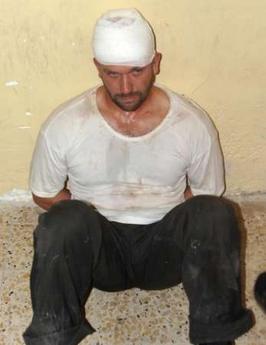
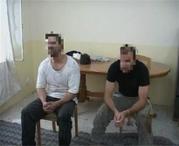
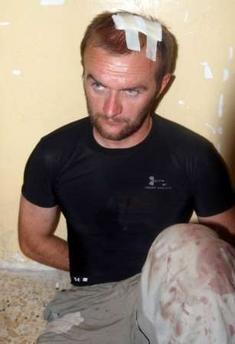
The photographs of the two men,
with their faces blocked out,
appeared on British television.
A note appeared at the bottom of the screen: "ATTENTION EDITORS - THE BRITISH GOVERNMENT REQUESTS THAT THE IDENTIFICATION OF THIS MAN IS NOT REVEALED, EITHER VIA PIXELLATION OF THEIR FACES OR BY NOT PUBLISHING THE PHOTOS."

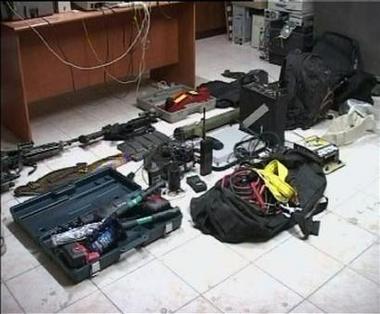
The white Toyota car, was later removed by the British. The BBC said that the gear in the car was ’standard kit’ for British special forces.’

The men were detained at the police station for questioning by a judge.
They were carrying a a plastic-coated card, ’ the only document found on the men. The card read in English: "In an emergency, please call US and UK forces on these numbers." There were phone numbers for the cities of Amara, Nassiriya and Basra."

According to Iraqi MP Ali Dabagh, the militiamen from the outlawed Madhi Army of Muqtada al-Sadr wanted the soldiers as hostages to exchange for two of their leaders arrested on Sunday by British forces.

That afternoon the British army came in tanks and armoured cars demanding the two be released. Lee Watson, 20, said he had driven through walls and over vehicles to get to them. There were “6 SAS people” in the back of his Warrior tank. He added, “They looked like computer characters with shotguns, machine guns, pistols and knives.” However, the two British men were not in the jail. Watson continues, "The helicopter gave us directions and we followed, stormed the street, rescued the two guys and got out. They had been battered half to death but were OK. They thanked us for saving their lives and two choppers came down and away they all went." More

A policeman, Abbas Hassan, told Reuters that a tank cannon struck a room where a policeman was praying." He was standing next to mangled cars outside the police station and jail that he said were crushed by British military vehicles. "This is terrorism. All we had was rifles."

BBC News: Video and Audio

Brigadier John Lorimor, commander of the 12th Mechanized Brigade, made a full statement, in which he said that "Minor damage was caused to the prison compound wall and to the house in which our two soldiers were held." More

The British Defence Ministry later admitted their intentional breach.

An Iraqi television cameraman who lives across the street from the jail said about 150 Iraqi prisoners also fled as British troops stormed inside and rescued their comrades. More


Blowback

The arrests sparked protests after British troops, backed by tanks, attempted to free the soldiers from the police station. (6 –12) other tanks, as well as helicopter gunships, were nearby. More


Two British armoured vehicles were attacked by a crowd, angered by the earlier arrests of two Basra citizens. Reuters television footage showed two British armoured personnel vehicles sent to the station attempting to reverse away from the crowd as it came under attack. As flames engulfed the vehicles, one soldier was seen scrambling from a top hatch, as he was pelted with stones and set on fire.

Mohammed al-Waili, the governor of Basra province, condemned the British for raiding the prison, an act he called "barbaric, savage and irresponsible"
"This is an irresponsible act," al-Waili said, adding that the British force had spirited the prisoners away to an unknown location. They were later released.

In an interview on Syrian TV, also on the 19th, Nidal Zaghbur spoke with his colleague in Baghdad, Ziyad al-Munajjid. Al-Munajjid said: “this incident gave answers to questions and suspicions that were lacking evidence about the participation of the occupation in some armed operations in Iraq. Many analysts and observers here had suspicions that the occupation was involved in some armed operations against civilians and places of worship and in the killing of scientists. “


Denouement

On Tuesday, 20 September, in a Reuters release Alaa Habib writes: “Residents of Basra, in a region with Iraq's biggest oil reserves, called on British troops to leave the country. ‘It is unappropriate for any Iraqi to be insulted by a British or an American or any other occupier, we reject the occupying forces,’ said Abbas Jassim. … "What the two Britons did was literally international terrorism … If the British had condemned this, it would have calmed the situation but instead they came and demanded them back which sets a dangerous precedent," Ali al-Yassiri, an aide to Sadr, told Reuters.

The Reuters report continues. At the Baghdad press conference, Haider al-Ebadi, an adviser to PM Ibrahim Jaafair, said, “It is a very unfortunate development that the British forces should try to release their forces the way it happened," Al-Ebadi also said that the two men “were acting very suspiciously like they were watching something and collecting information in civilian clothes in these tense times,"

In the same report, Brigadier John Lorimer, the British commander, said: "From an early stage I had good reason to believe the lives of the two soldiers were at risk," (see above, exchange of prisoners)

On Wednesday, 21 September, al Jazeera reported that about 300 Iraqis, including police officers in uniform, have demonstrated in the southern city of Basra. British forces made no attempt to control them … demonstrators carried banners calling for the return of the two British agents to face Iraqi justice. They also demanded the resignation of the provincial police chief, accusing him of being an agent of the British. "The British promised us sovereignty. So where is this sovereignty if they destroy a police station?" asked one demonstrator.

Also on 21 September, it was announced that Basra officials, following the British raid, had decided to boycott British troops. "All regular meetings between the governorate and British troops have been cancelled and we will not allow British soldiers into the governorate building or any other public office in Basra," Nadim al-Jaabari, spokesman for the provincial governor," told AFP on Thursday. More

On 21 September, alarmed by the focus on the UK SAS disaster, the Media started,
without investigation, to parrot spin about Iranian "insurgents" on the Iraq border. This "news" escalated during the following week.

On 22 September, Mohammed al-Waili told Reuters: "The governing council met yesterday and decided to stop all cooperation with the British until they meet three demands, To apologise for what happened, to guarantee that it does not happen again, and … to provide some compensation for all the damage they did during the operation," he said. The Reuters report continues: “British troops meanwhile confined themselves to their barracks in and around Basra, lowering their profile in an effort to tamp down tensions caused by Monday's raid.”

On 23 September, Adrian Blomfeld reported from Baghdad that
an Al-Sadr official said that the staged bombings were aimed at starting an ethnic war. More

On 24 September, 'Judge Ragheb Mohamad Hassan al-Muthafar told The Sunday Times in an exclusive interview that the soldiers were “suspects who attempted to commit a wilful act of murder”. According to the judge, nine people were killed and 14 injured, including two boys aged 13 and 14, when (the protestors) attacked British forces surrounding the police station where the men were detained. The Ministry of Defense is carrying out an investigation.' More

On Saturday 24 September, Reuters’ Abdel-Razzak Hameed reported that “an Iraqi judge has issued arrest warrants for two undercover soldiers of freed British soldiers.”

British military spokesman Major Steve Melbourne: replied: “We are not fully aware of the issue of these warrants…But what I must say is they have no legal basis for the issue of these." ,BBC Audio transcript, 0738

Also on the 24th, a “flurry of rockets was fired at buildings occupied by British troops.”

On 26 September, The Guardian reports that Karen McLuskie, a British diplomat in Basra, commented: “Britain refuses apology and compensation for Iraqis caught up in Basra riots.” More

29 September. British Hand Over Control of Basra More

On October 11th, Britain offers apologies and compensation for damaged buildings and personal injuries which they incurred in Basra following the arrests of the two UK soldiers.

Opinions
Elias Akleh, British Terrorism in Iraq
Ramzy Baroud, Iraq is an Occupied Nation in Revolt
William Bowles, Agents Provacateurs?
Pratap Chatterjee, Ex-SAS Men Cash In on Iraq Bonanza
Robert Fisk, When Nature and Man Conspire to Expose the Lies …
Michael Keefer: Were British Special Forces Planting Bombs in Basra?
Kurt Nimmo, Big Trouble for British Occupation of Southern Iraq
John Pilger, Sinister Events in a Cynical War
Tom Regan, The "Myth" of Iraq’s Foreign Fighters
Mike Whitney, Another Milestone in the War on Terror
Mike Whitney, Iraq: "A Right Rollicking Cock-up"


Researchers Notes

“The SAS involvement in Iraq was discovered on the 30th of January 2005 when an RAF Hercules plane crashed near Baghdad killing then British servicemen after dropping off fifty SAS members north of Baghdad to fight Iraqi guerillas.”

There is a history of occupied countries lacking any form of jurisdiction. This contradicts the ‘democratic’ principles propounded by the occupier. Human rights are systemically incurred - and ignored.


Part II : Mark Curtis, Web of Deceit and the SAS


On the day following Basra vs. The British, I opened the The Web of Deceit by Mark Curtis 1, to where I had left off, ‘Explaining the War Against Terrorism,’ which describes British undercover operations. Following is a summary of what Mark Curtis has written about the SAS, MI5 and MI6. I would like to thank Mark for allowing me to précis parts of his fine book. All quotes in the following sections are from The Web of Deceit, with one exception.

The SAS ‘Killer Squads

“An SAS officer noted: The SAS is the only agency whose job is to go out and zap people.” (p. 97)

Britain set up pseudo-terrorist ‘counter gangs’ in Palestine in the 1940s and Aden in the 1960s.” These consisted of “former terrorists and loyal tribesmen (Aden) led by British officers disguised as locals.” They were sent out in twos and threes to target those suspected of terrorism against British and local targets. (p. 96)

Aden (South Yemen): The SAS set up ‘hit squads’ whilst the RAF bombed villages and crops causing death and the evacuation of thousands. (p. 96)

Afghanistan: Former SAS officers trained Afghan mojahidins from the beginning of Soviet occupation. “Some SAS MI6 conducted ‘disruptive action’. KMS, (a private company) and then the SAS, trained commando units. Some Afghans were disguised and brought for training at a secret spot in Scotland. “Some SAS had back-up roles with the mojahidin.” (pp.62-3) 2 Britain supplied around 600 ‘Blowpipe’ … anti-aircraft missiles (later used by the Taliban) to these very same mojahidin, which shot down not only Soviet aircraft but passenger planes as well. Britain’s MI6 officers also supported and trained Afghan warlords. The CIA and MI6 trained Osama bin Laden’s supporters. The “war on terrorism” is “at least partly a creation of our (US, Saudi, Pakistan and Britain’s) making.” (p. 64)

Iran: The coup putting The Shah into power was arranged by the CIA and MI6.. (p. 310) The SAS “loaned soldiers to the Iranian military to help train the Shah’s special forces for operations against Kurdish guerillas in N. Iran.” MI6 was in contact with the Shah’s intelligence service, SAVAK; some SAVAK officers were trained in the UK in 1957. About 100,000 people were killed by the Shah’s regime. (pp. 313-4)

Northern Ireland: Modern ‘death squads’.

Kurt Nimmo has written an article about the SAS involvement in Northern Ireland. More


North Yemen: MI6 worked with tribesmen to ‘direct the planting of bombs’ at Egyptian military outposts while garrison towns were ‘shot up’ and political figures murdered.’ … MI6 “provided intelligence and logistical support to the rebels.” The rebels failed to dislodge the government. (p. 281)

Malaya: Between 1948 – 1960 a ‘counter-insurgency’ campaign against the Chinese was waged on behalf of rubber interests in the UK.
‘Killer squads’ were used in this brutal colonial war of decapitations, defoliants, detentions, villageisations’ and bombs. SAS squads from Rhodesia served alongside the British. The British declared this war an ‘emergency,’ and (as in the war in Afghanistan/Iraq) thus declared themselves immune from war crimes. (pp. 334 – 345)

Oman: Britain effectively controlled Oman, its oil, and the repressive Sultan. Britain was “therefore responsible for the repression.” (p. 277). There was a rebellion in Northern Oman, during which “the SAS fought a covert guerilla war whilst the UK Royal Air Force engaged in bombing and shelling of rebel villages and strongholds.” The “British ‘success’ was mainly due to inflicting terrifying violence.” The British ridded themselves of this Sultan and he came to live in the Dorchester Hotel.
Their next Sultan had his own personal 4-man SAS. “An SAS unit organized 1000 irregular forces to fight the rebels. Enemy corpses were
dumped in the main market square. (pp. 277 – 280)

Pakistan: SAS trained special Pakistani forces. (p. 62; see Afghanistan)

Palestine: “Squads were given a free hand to kill Jewish terrorists seeking an end to British rule and were able to adopt methods close to those adopted by the Jewish terrorists”… (p. 96)

Rhodesia: “former SAS officers were recruited… by the Central Intelligence Organisation (CIO) in the l970s.” (p. 97)

Zambia: the SAS were involved with bombings and assassinations against Rhodesian nationalists.


MI5, MI6 And Assassinations

“A long history has been buried. British government involvement in assassinating foreign leaders is virtually an elite tradition” (p. 95)

Hoxha, Albanian president, assassination plans by MI6, 1948. (p. 95)

Nasser, in the 1950’s: poisoned chocolate attempt; A SAS hit squad then considered other methods. (p. 95)

Sukarno of Indonesia: evidence of MI6 plot in 1950s. (p. 95)

Colonel Grivas, Cypriot guerilla leader: assassination plans by MI6 in late 1950s. (p. 95)

Dag Hammarskjold, 1959 plane crash: “meetings between MI5, the CIA and a South African military front company and plans to place TNT in the wheel bay of an aircraft.” described in letters. UK governmental denial of this was in a Guardian 1998 article. (p. 95)

Others considered: Chandra Bose India; The Mufti of Jerusalem (1950s) (p. 95)

Obote, Ugandan president: assassination plans by MI6 in 1969. (p. 95)

A bomb in Beirut, 1985, intended to kill Sheikh Fadlallah, the Shia leader, exploded. “Around eighty people were killed, including women and children, and over 200 wounded…The bombing was organized by the CIA and Saudi agents with the assistance of Britain’s MI6. 3 (p. 94)

Milosovic, President of Serbia: MI6 put forward three options for assassination in 1992. 1) with an SAS bomb/sniper ambush; 2) Serbian paramilitary group assassination; 3) road crash, eg. with strobe light. Later, NATO aircraft targeted him during Kosovo war. (p. 96)

The Quadafi Plot, Libya, 1996: MI6 cable revealing knowledge of assassination attempt by ‘one officer and twenty men being trained especially for this attack.’ “Claims that MI6 was in contact with ‘Osama Bin Laden’s main allies in the plot.” Quadafi was not killed; six innocent bystanders were. (p. 97) 4 MI6 paid £100,000 to the group. “Pure fantasy” said Robin Cook. Ben Bradshaw, Foreign Office Minister, later noted in 2002 that “There is no moral distinction between an attacker who kills civilians or parliamentarians and a state that wittingly provides the resources that facilitate such a terrorist attack. 5 (pp. 97-8)


British Torture & The British Army

1971 investigation: "The British found the British army had engaged in the torture of detainees … in counter-insurgency operations in Palestine, Malaya, Kenya, Cyprus, British Cameroons (1960 – 61), Brunei (1963), British Guiana (1964), Aden (1964-67), Borneo / Malaysia (1965 – 66), the Persian Gulf (1970 – 71) and in Northern Ireland (1971)." (pp. 280 – 81)

Footnotes
1. Mark Curtis, The Web of Deceit, Britain’s Real Role in the World, Vintage GB, 2003. Foreward by John Pilger. Back
2. Curtis footnote no. 30, Cooley, Unholy Wars, pp. 95-7, 81 Back
3.Curtis footnote 42, More Back
4. Curtis footnote no. 48: Dorril, MI6, p. 793; Richard Norton-Taylor, ‘Gagging orders issued in MI6 trial, Guardian, 7 October 2002 Back
5. Curtis footnote no. 50: More Back


Part III : Some Questions

Who is killing doctors in Iraq?

Who is killing journalists and photographers in Iraq?

Who is killing Iraqi teachers?

Who is killing Iraqi scientists?

Who shot Juan Torres in Bagram, Afghanistan?

Who are the "insurgents" kidnapping, beating and drugging people, forcing them to set off bombs that kill Iraqi citizens?

Who is being abducted and where are they?

What company is making the infrared bombs being used in Iraq?

Why are governments allowed to continue to commit torture and murder without fear of legal reprisal?

“State sponsored terrorism is by far the most serious category of terrorism in the world today.” (Curtis, ibid., p. 94)


Appendix : Blair Fiction fog

Spin is hypnotically interesting for journalists. The public becomes a ‘willing accomplice’ to the crime. The purpose of spin is to get the media, and thus the world, to take their eyes off the ball. In Basra, the eye was uncomfortably on the ball marked 'Two British Men Arrested.’ The most recent spin headlines in the UK media concern the alleged interference of the Iranian “insurgents” on the borders of Iraq. Bush supports this, being the original instigator of demonizing Iran.

The British SAS have been faffing around the Iranian border for two months.

The dubious Blair accusation about Iranian “insurgents” was first noticed, I believe, by Kurt Nimmo in his blog Media Shifts Attention from SAS Screw Up to Iran on the 21st of September.

Blair Fiction Fog followed the Basra officials' announcement to boycott British troops
Going yet further back, it can also be seen as a response to the Iranian steadfastness to following its nuclear power development.

This Blair-Spin is now reaching epic proportions, with denials from both Iran and Hizbollah.

The accusation is but a part of the plan to make Iran “dangerous”, in the same way as Saddam was “dangerous” with his WMDs.
When the US government feels the spin has seeded, then the (now deleted from Web) DOD nuclear plan of preemptive strike can then be activated. (Document available here)

While God speaks to Bush, we spin along our way, like lemmings, towards the cliff edge.
Photo Charles Dharapak/AP

Is the focus by US/UK governments on Iran's 'nuclear weapons buildup' a subterfuge
for a US war on Iran to control its oil? The interference of the UK in matters Iranian continues with Iran Focus writing, on 17 October, that a person admitting to being trained by the British in Iraq was arrested for his part in the twin Ahwaz bombings.

Clearing the Fiction Fog. What information about Iran is now being hidden from the public? There is US/UK sabre rattling about "War in Iran" because of an alleged nuclear 'threat.' Any war in Iran would be for the same reason as the war in Iraq - OIL.
This article by physicist Gordon Prather on 22 October 2005 tells us what we are not being told about 'matters nuclear' in Iran.

FOOTNOTES: January 4 2006. THE US GOVERNMENT DROPS ALLEGATIONS OF IRAN INVOLVEMENT IN IRAQ.

Updates

01.04.06. Dominic Kennedy, uruknet. Iranian militiamen were brought in by Britain

DoD Contract, 11.08.06.
Blackwater Security Consulting, Moyock, N.C., was awarded on Aug. 7, 2006, a $7,161,101 firm-fixed-price contract for personal security detail services - protection security services. Work will be performed in Baghdad, Iraq, and is expected to be completed by September 30, 2008. Contract funds will not expire at the end of the current fiscal year. There were an unknown number of bids solicited via the World Wide Web on March 25, 2006, and 21 bids were received. The Joint Contracting Command, Baghdad, Iraq, is the contracting activity (W91GY0-06-C-0027).


Exposing Gordon Kerr and Tony Blair’s secret army
07.04.07. Simon Basketter exposes how special British units in Iraq are run by the same man who commanded death squads in Northern Ireland.


Sarah Meyer is a researcher, living in Sussex, England. She is also a “citizen reporter” for www.mediachannel.org.
email: sarahmeyer@freedom255.com


Creative Commons License
This work is licensed under a Creative Commons License.


Tags: , , , , ,

Labels: , , , , , , , , ,

Obama’s Iraq: NO ‘CHANGE’ (updated 23.07.09)

THE BATTLE FOR BASRA TIMELINE: Footsteps to U.S. War in Iran?

Haditha: Crime and Punishment (updated 20.03.09)

Iraq: New U.S. Base - Wasit(updated 17.08.08)

IRAQ: WHAT DOES ‘JOB DONE’ MEAN?

Iraq Oil Reality vs the NY Times

Iraq Oil: The Vultures are Waiting(Updated 11.11.09)

The Iraq Oil Crunch: Index Timeline (updated 03.01.08

IRAQ: Green Zone Blowback: Index Timeline(update 06.01.09)

Index on Iraq: a journey in hell

Iraq: The "Grateful" Dead

Haditha: The Mai Lai of Iraq

The Haditha Doctor and The Media Dissemblers

Front Page Slander

Camp Falcon : What Really happened?(Updated 28.02.07)

US/UK Bases in Iraq, Part II. The South (updated 06/06/08)

Iraq: The Assassination of Academics : The Jalili Report

Iraq: The Occupation is the disease

Iraq's US/UK Permanent Bases : Intentional Obfuscation

Iraq: Security Companies and Training Camps

US Bases in Iraq: Part I: Baghdad (updated 06/06/08)

Iraq: Victims of Violence (Updated 03/03/07)

Prisons and Torture in Iraq (Updated 12/12/06)

Basra Shadowlands

Iraq: Unseen Dead

Powered by Blogger

Subscribe to
Posts [Atom]